


Opisthoncus mileshendyi is newly described from Tasmania and Victoria (Australia). The diagnosis, description and diagnostic figures are given, and remarks on distribution, biology and relationships are provided. Along with this previously undescribed species of Opisthoncus, this paper also provides a redescription of the female of Opisthoncus sexmaculatus (C.L. Koch, 1846). This paper also describes the previously undescribed male of the same species.
Jumping spiders are one of the most diverse spider families in the world with over 6815 species (WSC, 25 June 2025); 501 of which have been recorded from Australia (AFD, 18 April 2025). Opisthoncus is one of 91 salticid genera occurring in Australia (AFD, 18 April 2025). They are quite large and often easily recognised, at least to genus. Unusually males have enlarged chelicerae with characteristically large fused teeth; females are not so dramatically modified. A common feature of the genus is the small cephalic protuberance located centrally in a dark band between the posterior lateral eyes. Many of the species have a double row of dark patches or figures along the dorsal surface of the abdomen as observed in the two species described here. This is another feature of the genus. Very little is known of their biology, mating behaviour and little of their taxonomy.
The genus Opisthoncus (L. Koch, 1880 ), includes 32 described species (World Spider Catalogue, version 26), 25 of which were treated by Gardzinska & Żabka (2013). Species of Opisthoncus have been reported Australia-wide, New Guinea and Lord Howe Island, but not in Norfolk, Christmas or Cocos Keeling Islands. Since 1920, no new species have been added to the list. The genus is clearly understudied owing to the number of species collected for which there is no description and according to Marek Zabka (pers. comm.), some 100 species can be expected in Australia, including Tasmania.
Specimens of a distinctive species of Opisthoncus have been observed around Launceston which could not be assigned to a described species. However, it appeared to be similar to O. sexmaculatus (C.L. Koch, 1846) (see C.L. Koch, 1846; Simon, 1903; Gardzińska & Zabka, 2013) (Fig. 1) (Fig. 6), as indicated by the double row of dark patches along the abdomen. This paper provides a description of the Tasmanian species (which is also recorded from Victoria) and is compared with O. sexmaculatus, which is redescribed from specimens collected in Western Australia.
Microscopic photos were taken with a Leica EZ4 W microscope with inbuilt camera linked to an Apple Macbook Pro. Multiple images were taken on different focal planes and combined using Photoshop software.
Habitus photographs of Opisthoncus mileshendyiwere taken using an Olympus TG6 using inbuilt image stacking. Opisthoncus sexmaculatus habitus photos were taken with a Canon EOS R5 and a Canon 100mm rf speedlight macro lens.
Map diagrams by author.
Measurements are given in millimetres.
Abbreviations used in the text are as follows:
CL cephalothorax length, CW cephalothorax width, CH cephalothorax height, AL abdomen length, AW abdomen width, AEW anterior eye row width, PEW posterior eye row width, EFL eye field length, PLE posterior lateral eyes, L1 leg 1, QVM Queen Victoria Museum and Art Gallery, Launceston, Tasmania, WAM West Australian Museum, ALA Atlas of Living Australia.
Specimens of the new species were collected by beating of tree branches. After photographing live spiders, they were euthanased by freezing, then preserved in 80% Ethanol. Prior to examination, dissected female genitalia cleared in lactic acid for 24 hours at room temperature.
Specimens of Opisthoncus mileshendyi are deposited in the collection of the Queen Victoria Museum, Launceston, Tasmania, while specimens of Opisthoncus sexmaculatus are held at the West Australian Museum and the lectotype female at the Museum für Naturkunde, Berlin.
Distribution
The spiders of the new species were collected in Churchill Park, Invermay, Launceston, northern Tasmania (Fig. 2). After extensive searching in the same parkland, no further specimens were found however, specimens were collected from the same tree over an 18 month period. Subsequently another specimen was found at a roadside stop at Paramatta Park, 79 kilometres to the north-east. No other specimens have been recorded from Tasmania. (Fig. 3). One specimen has also been recorded from Victoria.
The second species, Opisthoncus sexmaculatus, treated here occurs in coastal Western Australia (Fig. 9).
According to the Atlas of Living Australia, occurrences of O. sexmaculatus have been recorded 767 times, mostly from Queensland, New South Wales, Victoria and Western Australia, with 1 specimen recorded for Tasmania. As none of the specimens shown on ALA are substantiated by documentary or microscopic evidence, but are of human observation it cannot be verified that the specimens are actually O. sexmaculatus. However, from the images shown most appear to be of the new species described here, apart from the four specimens shown to be from Western Australia which are consistent with O. sexmaculatus.
Despite intense sampling of spiders around Tasmania conducted over the last 10 years, no other specimens of this O. mileshendyihave been collected. This does not preclude that other localities of the species may exist in unsampled areas. It is also notable that within the park where the species occurred, no specimens were found on other species of trees, or other blackwood trees.
While O. mileshendyi is unusual in Tasmania, it is only one of a number of Opisthoncus species that are commonly found around the state that have not yet been described.
Biology
The specimens of O. mileshendyi were collected from the foliage of one particular blackwood tree (Acacia melanoxylon) (Fig. 2). Also found with these spiders were other species, including crab spiders (Thomisidae), sac spiders (Clubionidae), numerous small cockroach nymphs (Blattidae) and small caterpillars. The cockroaches are numerous and being soft bodied, make good prey for the jumping spiders.
Living specimens of the Opisthoncus sexmaculatus photographed were exclusively found on the leaves of the grass tree (Xanthorrhoea preissii) (Fig. 6 D), a Western Australian native shrub. Other preserved specimens also have been recorded on the grass tree.
Family Salticidae
Subfamily Salticinae
Genus Opisthoncus L. Koch, 1880
Figs 1-5
Type specimens
Holotype. AUSTRALIA: Tasmania: female, Launceston (-41.41545, 147.14005), 6 June 2024, J. Douglas (QVM:2024:13:0228).
Paratype. AUSTRALIA: Tasmania: 1 male, Launceston (-41.41545, 147.14005), 21 February, 2023, J. Douglas (QVM:2024:13:0216).
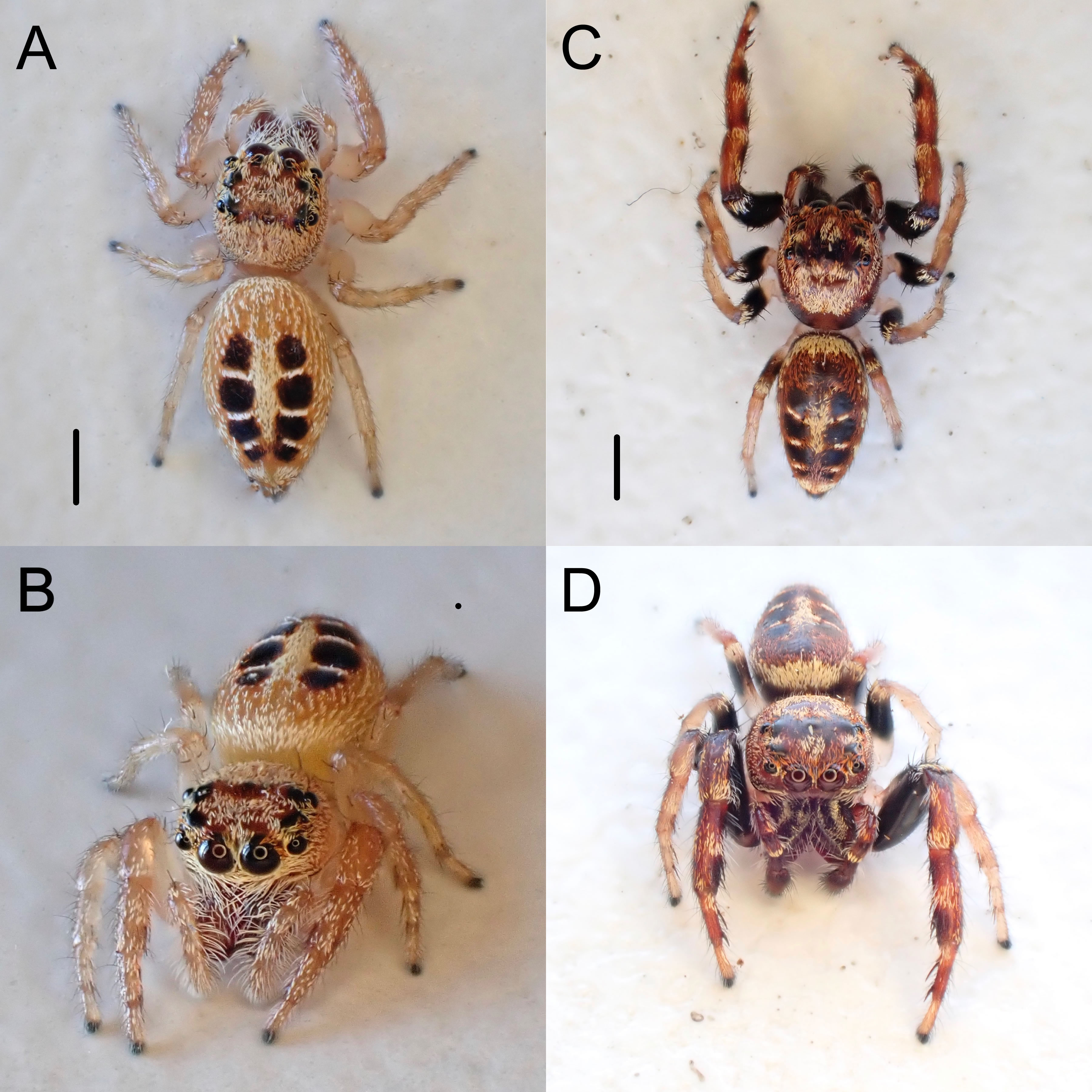
Figure 1. Opisthoncus mileshendyi, sp.nov. A: habitus female; B: habitus male; C: facing view female, D: facing view male. Scale bars: 1 mm.
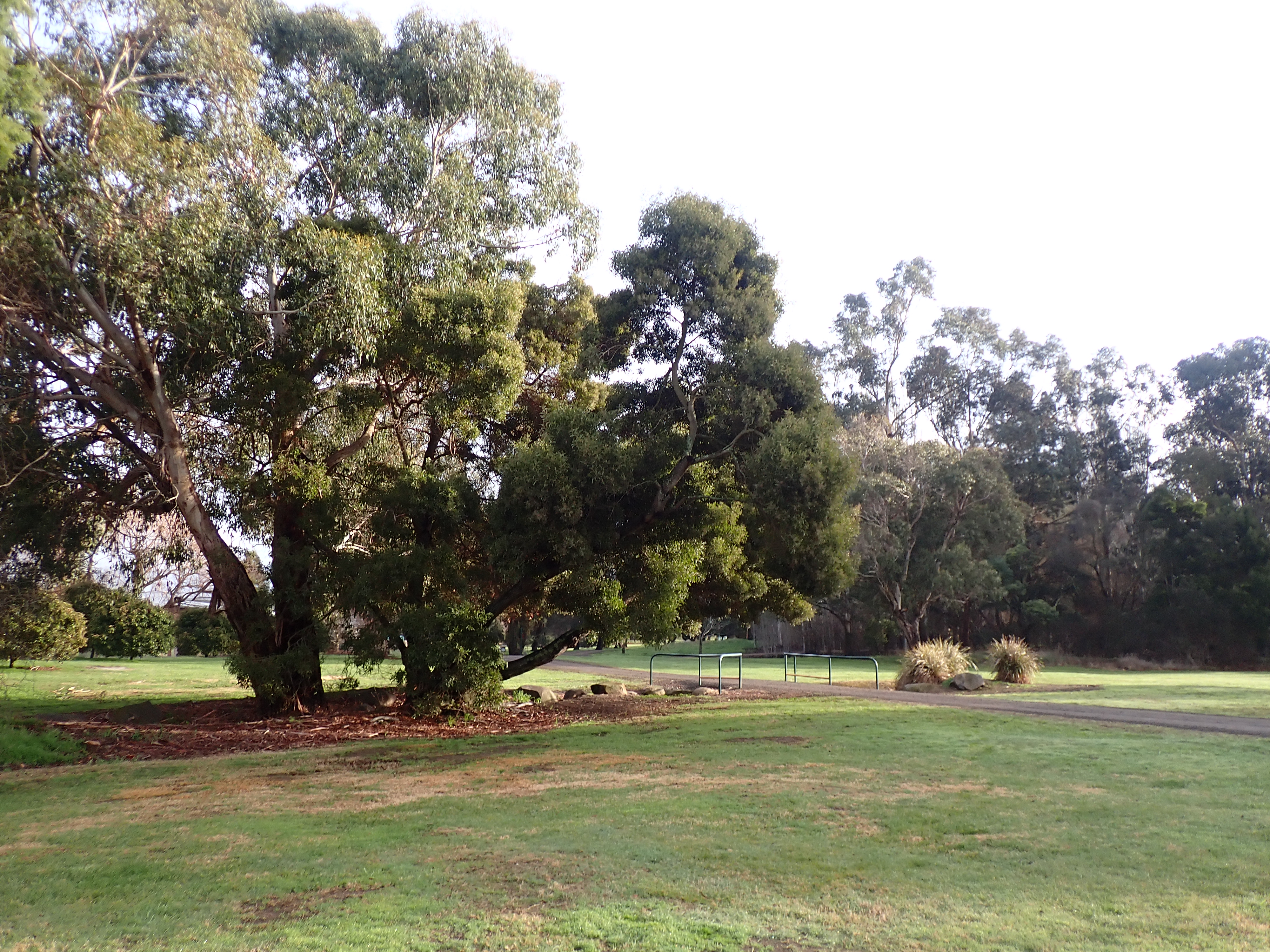
Figure 2. Blackwood tree (Acacia melanoxylon) where specimens were collected in Churchill Park, Invermay, Launceston.
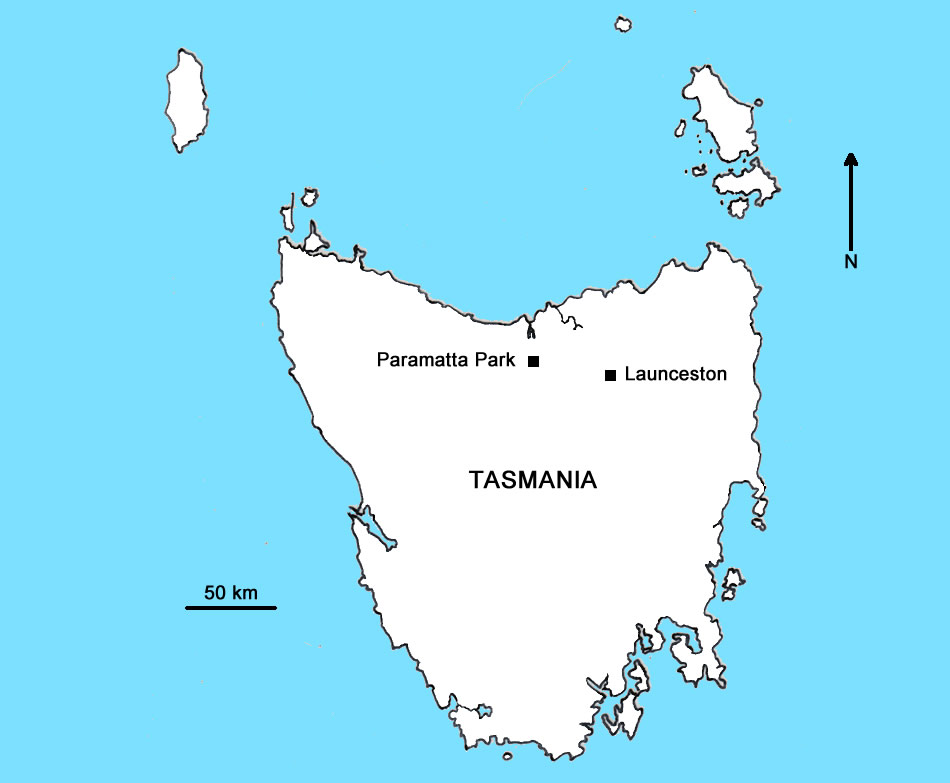
Figure 3. Known distribution records of Opisthoncus mileshendyi sp.nov. in Tasmania.
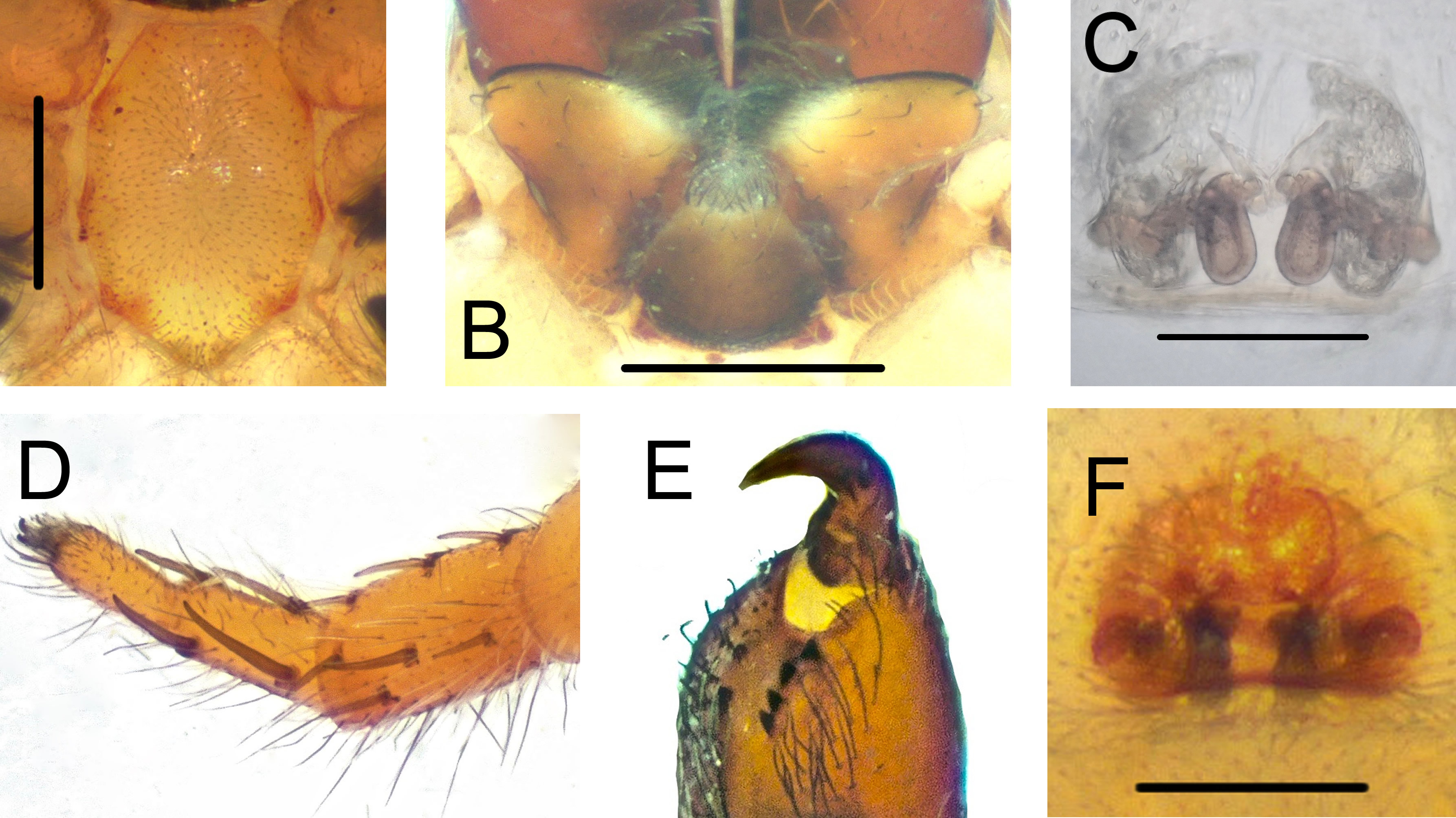
Figure 4. Opisthoncus mileshendyi, sp.nov. Female holotype. A: Sternum; B: maxillae and labium; C: epigyne, dorsal view; D: leg1 showing spurs on tibia and metatarsus; E: Chelicera showing teeth; F: epigyne, ventral view. Scale bars A and B 0.5 mm, C and F 0.25 mm.
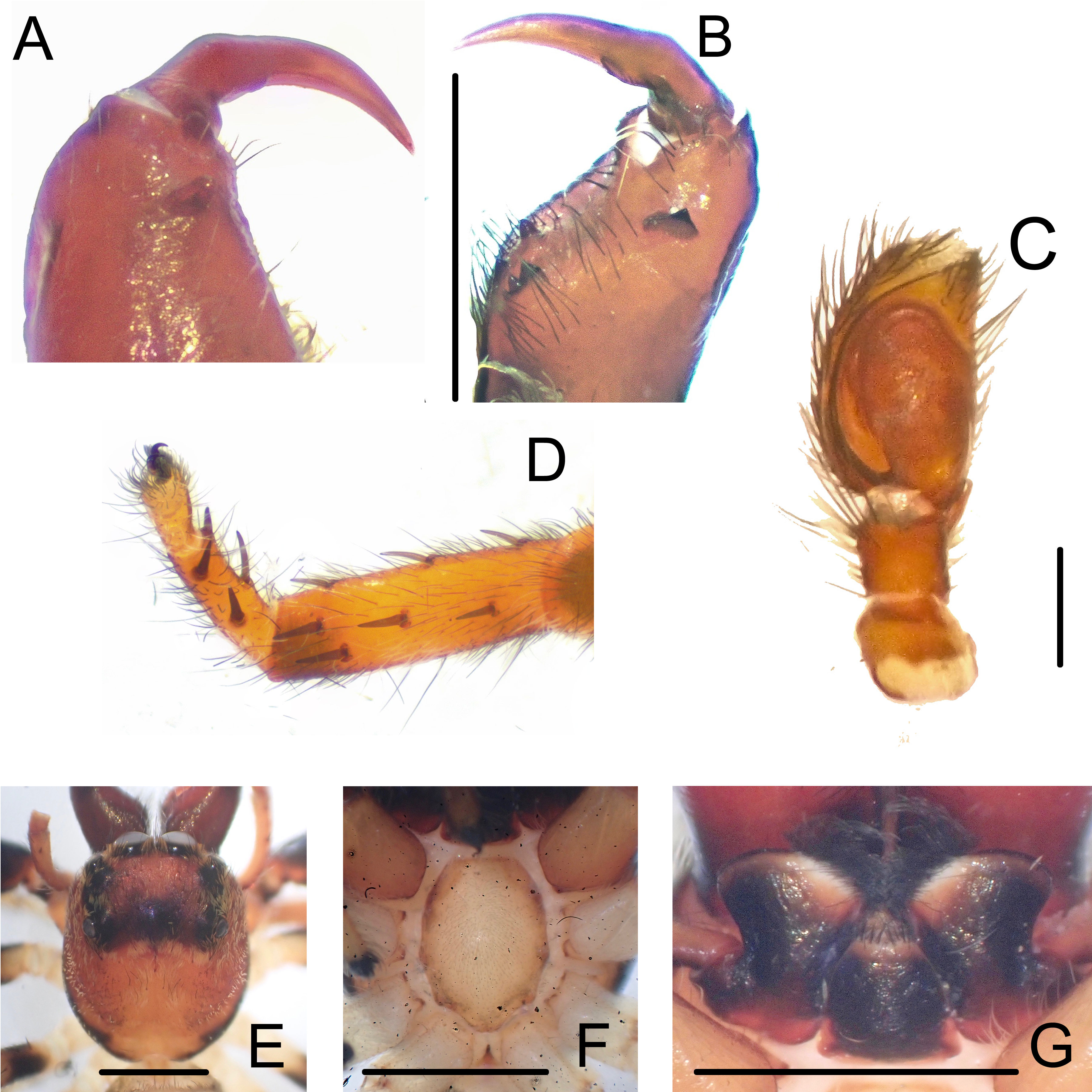
Figure 5. Opisthoncus mileshendyi, sp.nov. Male allotype. A: chelicerae, dorsal view; B: chelicerae, ventral view; C: palp, ventral view; D: leg 1 showing spines; E: carapace; F sternum; G: maxillae and labium. Scale bars B,E,F,G: 1 mm; C: 0.25 mm.
Carapace with a small cephalic protuberance between PLE. Chelicerae in males inclined forward. Female chelicerae with four cuspidate fissident tooth retrolaterally (Fig. 4 E). Male chelicerae with retromarginal spur and large frontal spur (Fig. 5 A, B). Male and female abdomens featuring eight prominent black patches (Fig. 1 A , C), which differ from Opisthoncus sexmaculatus in that the patches are sharper edged and separated by white lines. Copulatory openings wide orientated anteriorly, insemination ducts moderately long with internal structures as in Fig. 4 C. The epigyne of the female of the new species has close similarity to Opisthoncus polyphemus(L. Koch, 1867) while the male pedipalps show similartity to Opisthoncus confinis, L. Koch, 1881. As noted, in life the new species appears as similar to Opisthoncus sexmaculatus (C.L. Koch, 1846 Simon, 1903, Gardzińska & Zabka 2013) (Fig. 1)(Fig. 6), as indicated from the double row of dark patches along the abdomen. However Opisthoncus sexmaculatus is a predominantly yellow spider compared to the new species.
Holotype female (Figs 1 A, B, 4) QVM:2024:13:0228. 4.5 mm long.
Carapace round (CW =70% of CL) and moderately high (CH= 0.48% CL), reddish-brown, covered with recumbent, pale yellow setae. Surrounds of distal eyes black. Dark brown band extending between PLE with black, cephalic protuberance on centerline. Clypeus wide, brown, covered with numerous pallid long hairs. Chelicerae (Fig. 4E) dark brown. Retromargin four teeth decreasing in size proximally. Promargin two teeth of increasing in size proximally. Labium dark brown with lighter anterior margins. Maxillae light brown with black margins. Sternum ovate, cream coloured, darker marginally.
Abdomen (Fig. 4 C, F) elongate, dorsal light brown covered in pale yellow setae and eight black patches separated by white bands as in Fig. 1 A. Venter light grey, white laterally with central elongate stripes of small grey dots. Spinnerets light brown.
Legs (Fig, 4 D) light yellow. Ventral metatarsus of L1 with paired prolateral and retrolateral spines, tibia with 3 pairs of ventral spines and one prolateral spine at distal end.
Dimensions CL 2.13, CW 1.62, CH 1.08, AL 2.56, AW 1.94, AEW 1.33, PEW 1.43, EFL 1.00, L1 3.81(1.07+0.77+0.96+0.47+0.54).
Paratype male (Figs 1 C, D, 5) QVM:2024:13:0216. 5 mm long.
Carapace round, moderately high (CW =77% of CL, CH= 72% CL), reddish-brown, covered with recumbent, pale yellow setae. Surrounds of eyes black. Dark brown band extending between PLE with black, cephalic protuberance on the centerline. Clypeus wide, but narrow, devoid of setae except for narrow band of setae laterally. Chelicerae dark brown. Retromargin three teeth ranging from small proximally to large distally. Promargin similar, but spaced further apart. Single spurs distally on ventral and dorsal surfaces of basal segment. Labium brown with lighter anterior margins. Maxilae light brown with black margins. Sternum ovate, cream coloured, darker marginally.
Abdomen elongate, dorsal yellow with brown overlay and eight black patches as in Fig. 1 C. Venter black, whitish sides with central elongate stripes of small orange dots. Spinnerets black.
Legs I and II dark brown with black and yellowish bands, femora black. Legs III and IV light brown, femurs light brown, black distally. Ventral metatarsus of LI with 2 pairs of prolateral and retrolateral spines, tibia with 3 pairs of ventral spines and 1 prolateral spine at distal end. Palpal organ (Fig. 5 C) tegulum moderately narrow, elliptic, embolus set prolaterally at 6 o’clock. Spermophore not meandering. Tibia about 30% of cymbium length.
Dimensions.CL 2.29, CW 1.76, CH 1.04, AL 2.83, AW 1.54, AEW 1.30, PEW 1.34, EFL 0.92, L1 6.39 (1.75+1.30+1.50+1.00+0.74).
Other material examined
AUSTRALIA: Tasmania: 2 females, Launceston (-41.41545, 147.14005), 29 December 2022, J. Douglas (QVM:2022:13:0473, 0474); 2 females, same data except 21 February 2023 (QVM:2024:13:0217, 0218); 3 females, same data except 27 April 2024 (QVM:2024:13:0223, 0224, 0225); 2 females, same data except 6 June 2024 (QVM:2024:13:0227, 0229); 1 male, same data except 29 December 2022 (QVM:2022:13:0475); 2 males, same data except 21 February 2023 (QVM:2024:13:0214, 0215); 1 male, same data except 13 May 2023 (QVM:2024:13:0219); 2 males, same data except 19 April 2024 (QVM:2024:13:0221, 0222); 1 male, same data except 27 April 2024 (QVM:2024:13:0226); 1 female, Paramatta Park (-41.33025, 146.5302), 6 January 2024, J. Douglas (QVM:2024:13:0220).
Victoria: 1 female, Balwyn (-37.8075, 145.098889), 6 January 1982, M.S. Harvey (WAM T165468).
Figure 1. Opisthoncus mileshendyi, sp.nov. A: habitus female; B: habitus male; C: facing view female, D: facing view male. Scale bars: 1 mm.
Figure 2. Blackwood tree (Acacia melanoxylon) where specimens were collected in Churchill Park, Invermay, Launceston.
Figure 3. Known distribution records of Opisthoncus mileshendyi sp.nov. in Tasmania.
Figure 4. Opisthoncus mileshendyi, sp.nov. Female holotype. A: Sternum; B: maxillae and labium; C: epigyne, dorsal view; D: leg1 showing spurs on tibia and metatarsus; E: Chelicera showing teeth; F: epigyne, ventral view. Scale bars A and B 0.5 mm, C and F 0.25 mm.
Figure 5. Opisthoncus mileshendyi, sp.nov. Male allotype. A: chelicerae, dorsal view; B: chelicerae, ventral view; C: palp, ventral view; D: leg 1 showing spines; E: carapace; F sternum; G: maxillae and labium. Scale bars B,E,F,G: 1 mm; C: 0.25 mm.
Etymology
The specific epithet is a patronym for Miles Hendy, currently a 15 year old student in Hobart who has demonstrated a keen interest in spiders. He has assisted in a number of field exercises collecting spiders for the QVM collection and assisted in laboratory work identifying spiders. His name for this spider has been chosen as an encouragement to other young science enthusiasts who are looking at a career in the natural sciences.
Plexippus sexmaculatus C.L. Koch, 1846: 119, fig. 1169.
Gangus sexmaculatus (C.L. Koch): Simon, 1903: 700.
Opisthoncus sexmaculatus (C.L. Koch): Zabka, 1991: 47.
Opisthoncus sexmaculatus (C.L. Koch): Gardzinska & Zabka, 2013: 442, fig. 28A-D.
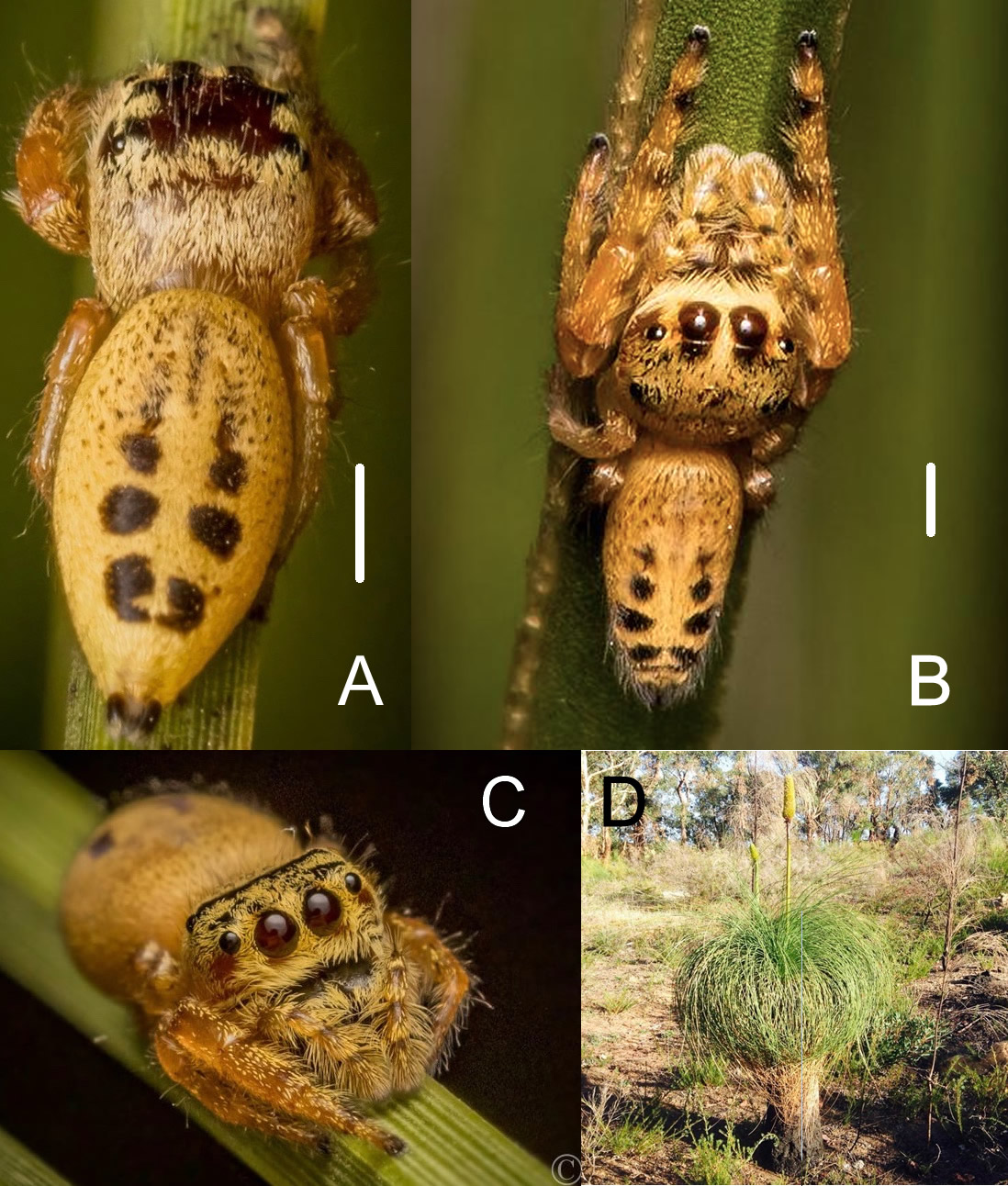
Figure 6. Opisthoncus sexmaculatus, (C.L. Koch, 1846). A: habitus female; B: habitus male; C: facing view female, Photos: K. Taylor. D: West Australian grass tree, Xanthorrhoea preissii. Photo: R. Douglas. Scale bars: 1 mm.
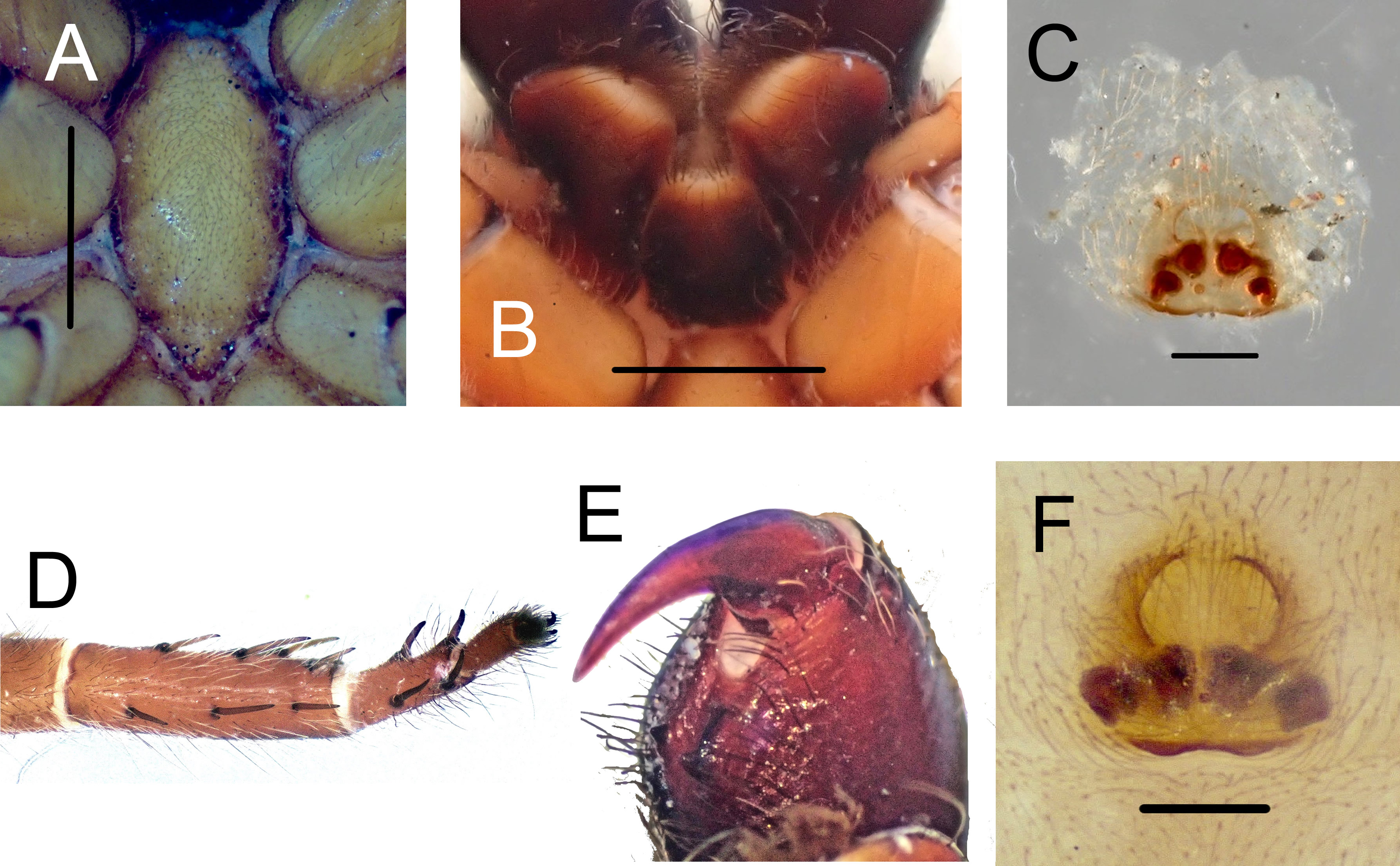
Figure 7. Opisthoncus sexmaculatus. Female. A: Sternum; B: maxillae and labium; C: epigyne, dorsal view. Photo: Oskar Werb; D: leg1 showing spines on tibia and metatarsus; E: Chelicera showing teeth; F: epigyne, ventral view. Scale bars A and B 0.5 mm, C and F 0.25 mm.
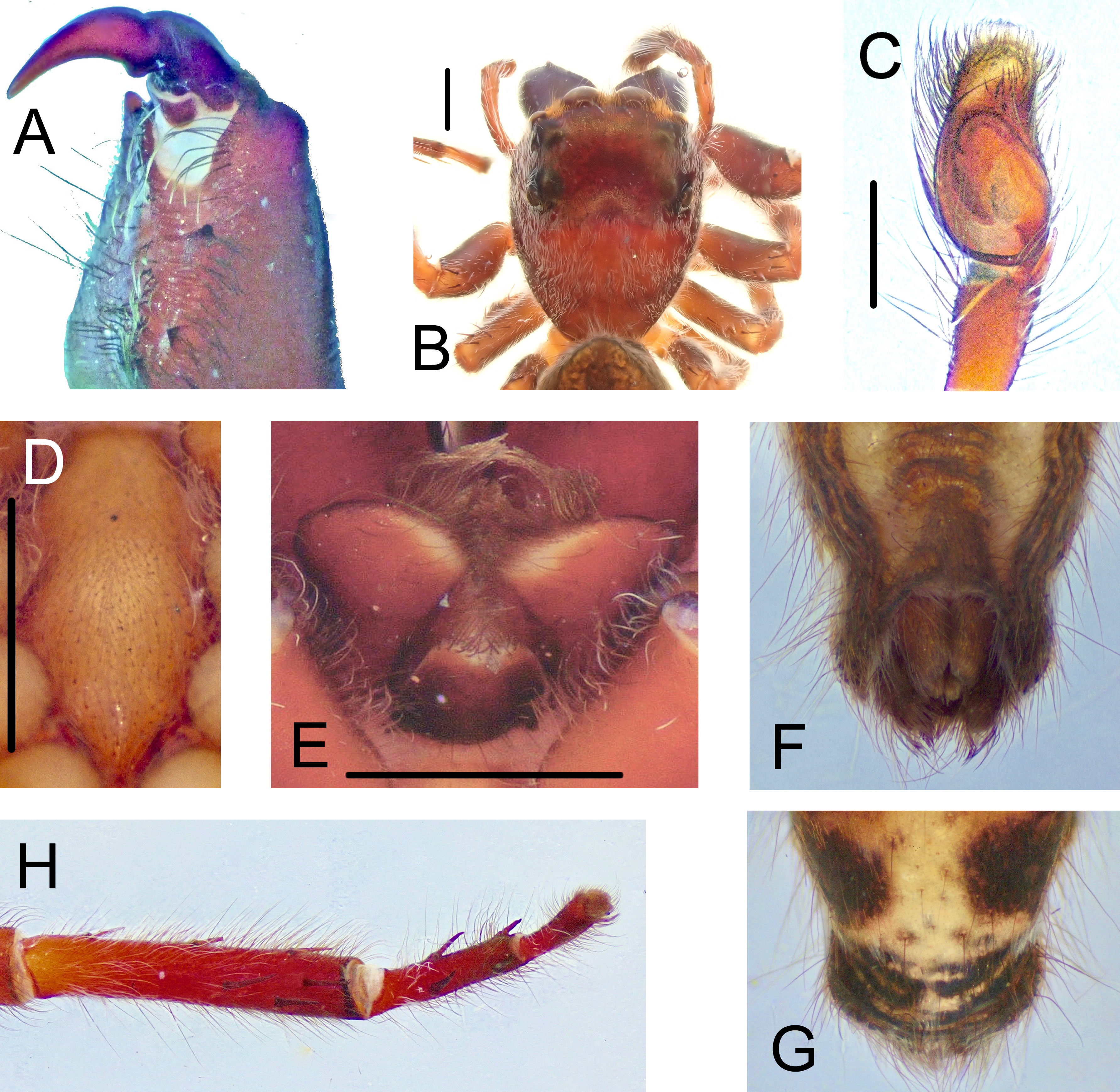
Figure 8. Opisthoncus sexmaculatus. Male. A: chelicera, ventral view; B: carapace, dorsal view; C: palp, ventral view; D: sternum; E: maxillae and labium; F: spinnerets, ventral view; G: distal end of abdomen showing ring; H: leg 1 showing spines on tibia and metatarsus; Scale bars B and D; E: 0.5 mm; C: 0.25 mm.
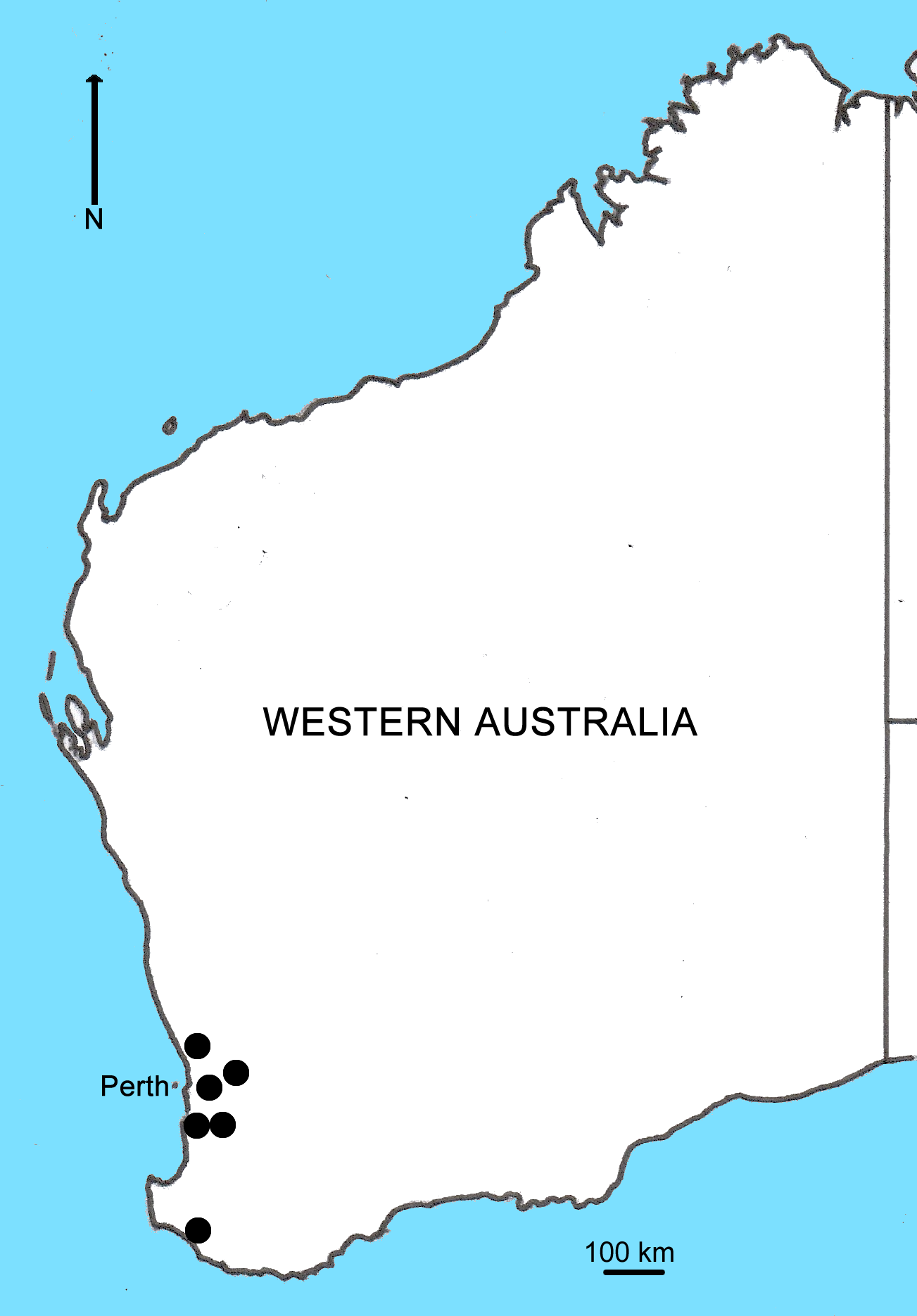
Figure 9. Known distribution records of Opisthoncus sexmaculatus in Western Australia.
Carapace with a small cephalic protuberance between PLE. Chelicerae in males inclined forward. Female chelicerae with 2-cuspidate fissident tooth retrolaterally (Fig. 4 E). Male chelicerae with two teeth widely spaced on retromargin and a large promargin spur (Fig. 5 A , B). Male and female abdomen featuring six prominent black patches (Fig.1 A , C), which differs from Opisthoncus mileshendyi in that the patches have less clearly defined edges. Copulatory openings relatively small. Insemination ducts moderately long with internal structures. (Fig. 7 C).
Female (Fig. 6 A, C, 7) WAM: T165470. 8.5 mm long.
Carapace round, (CW=77% of CL) and moderately high (CH=51% of CL), Dark brown over eye field area, reddish brown distally, covered with recumbent yellow setae. Black patches distally of AME. Dark brown band extending between PLE on more mature specimens, with cephalic protuberance on the centerline. Clypeus wide , yellow, covered with numerous pallid long hairs and scales. Chelicerae dark brown. Retromargin 2-cuspidate fissident tooth, promargin three small teeth. Labium and maxillae dark brown with lighter anterior margins. Sternum elongated oval, cream coloured.
Abdomen elongate. The dorsal surface yellow with six distinct black patches in two rows distally and two lighter black markings anteriorly. Anterior surface of abdomen has field of small speckled dark spots. Venter pale yellow with darker central stripe tapering distally to spinnerets. Spinnerets dark brown.
Legs dark yellow. Ventral metatarsus of L1 with two paired spines on prolateral and retrolateral surfaces. Tibia with 3 pairs of ventral spines on prolateral and retrolateral surfaces and one central spine between distal pair.
Dimensions. CL 4.03, CW 3.12, CH 2.04, AL 4.49, AW 2.63, AEW 2.19, PEW 2.65, EFL 2.13, L17.96 (2.13, 2.06, 1.80, 1.08, 0.89).
Male (Fig. 6 B, 8) WAM: T165472. 8.4 mm long.
Carapace trapezoidal and moderately high. (CW=73% of CL. CH=56% of CL), reddish brown, covered with recumbent dark yellow setae. Black patches distal of anterior median eyes. Cephalic protuberance on the centerline between PLE. Clypeus wide with long pale yellow setae. Chelicerae dark brown. Retromargin two teeth spaced wide apart. Promargin no teeth, but single large spur on distal surface of basal segment. Labium brown with lighter anterior margin. Maxillae light brown with dark brown margins. Sternum yellow, elongated , rounded anteriorly, tapered distally with distinct indentations bordering coxa of leg two.
Abdomen elongate, tapering distally to a horseshoe-shaped ring which surrounds the tip of the abdomen, apart from the spinneret area. The dorsal surface yellow with six distinct black patches in two rows distally and two lighter black markings anteriorly. Anterior surface has field of small dark dots. Long setae on distal portion of abdomen. Venter light brown with dark brown lateral stripes and dark brown central stripe. Spinnerets dark brown.
Legs I yellow with black patch on proximal surface of metatarsi. Legs II, III and IV yellow. Ventral metatarsus of LI with 2 pairs of prolateral and retrolateral spines. On the ventral surface of the tibia a single retrolateral spine at the proximal end plus 2 pairs of prolateral and retrolateral spines at the distal end and a single spine centrally at the distal end. Palpal organ tegulum elliptical, embolus set prolaterally, long and arising at 4 o’clock, spermophore narrow and not wandering, tibia about 65% of cymbium length.
Dimensions. CL 4.40, CW 3.24, CH 2.45, AL 3.98, AW 2.25, AEW 2.59, PEW 2.66, EFL 1.46, L1 11.95 (2.92, 2.56, 3.39, 1.80, 1.28).
Material examined
AUSTRALIA: Western Australia: 1 female, Banganup Lake (-32.166667, 115.816667), 30 March 1990, M.S. Harvey, J.M. Waldock (WAM T165470); 1 female, same data except 31 March 1990, A.E. De Jong (WAM T165466); 1 female, Black Point, D’Entrecasteaux National Park (-34.416667, 115.55), 28 December 1951, B.Y. Main (WAM T165376); 1 juvenile, Darlington (-31.916667, 116.066667), 19 June 1949, unknown collector (WAM T165469); 1 juvenile female, Neerabup National Park (-31.650556, 115.730278), 9 September 2006, M.G. Rix, J.M. Waldock (WAM T99375); 1 male, North Bannister (-32.533333, 116.383333), 4 October 1987, M. Peterson, B. Coulson (WAM T165472); 1 female, Tim’s Thicket (-32.666667, 115.616667), 18 September 1988, G. Harold (WAM T165467); 2 males, 1 female, Trigg Reserve (-31.868889, 115.760278), 17 September 1988, M. Zabka, D. Knowles (WAM T19314, T19315, T19316); 1 juvenile, Trigg (-31.866667, 115.75), 6 September 1988, D. Knowles (WAM T165471).
Figure 6. Opisthoncus sexmaculatus, (C.L. Koch, 1846). A: habitus female; B: habitus male; C: facing view female, Photos: K. Taylor. D: West Australian grass tree, Xanthorrhoea preissii. Photo: R. Douglas. Scale bars: 1 mm.
Figure 7. Opisthoncus sexmaculatus. Female. A: Sternum; B: maxillae and labium; C: epigyne, dorsal view. Photo: Oskar Werb; D: leg1 showing spines on tibia and metatarsus; E: Chelicera showing teeth; F: epigyne, ventral view. Scale bars A and B 0.5 mm, C and F 0.25 mm.
Figure 8. Opisthoncus sexmaculatus. Male. A: chelicera, ventral view; B: carapace, dorsal view; C: palp, ventral view; D: sternum; E: maxillae and labium; F: spinnerets, ventral view; G: distal end of abdomen showing ring; H: leg 1 showing spines on tibia and metatarsus; Scale bars B and D; E: 0.5 mm; C: 0.25 mm.
Figure 9. Known distribution records of Opisthoncus sexmaculatus in Western Australia.
Etymology
The specific epithet is evidently a reflection of the six dark patches, which appear on the abdomen of the species.
Remarks
In addition to the specimens listed above, images of the original female specimen (ZMB_Arach_1733), described by C. L. Koch and held at Museum für Naturkunde, Berlin, was examined.
Nil
I wish to thank Dr Robert Raven (Queensland Museum) for his continued support and assistance with technical issues, Professor Marek Żabka (University of Siedlce, Poland) for his editorial assistance and encouragement to continue the description of the Opisthoncus genus of Salticids, my arachnophobic wife Rainie Douglas for her tolerance of my obsession with spiders, Alfonsina Arriaga-Jiménez, Senior Curator, Natural Sciences, for her editorial help, Simon Fearn and Judy Rainbird, Collections Officers Natural Sciences at the Queen Victoria Museum, Launceston for their support and encouragement to complete this project. Thanks too to Jason Dunlop, curator of arachnids and myriapods at the Museum für Naturkunde, Berlin for locating C.L. Koch’s specimen of Plexippus (Opisthoncus) sexmaculatus, Oskar Werb for taking photographs of the original female specimen and Kaylene Taylor for her photographs of live Opisthoncus sexmaculatus spiders. Robert Douglas for grass tree photo. Also Dr Volker Framenau for selecting specimens from the WAM collection and Julianne Waldock for arranging for specimens to be sent for my research.
Gardzinska, J & Żabka, M. 2013. Redescription of the genus Opisthoncus, L. Koch 1880 (Araneae: Salticidae). Zootaxa 3717: 401-447.
Koch, C. L. (1846). Die Arachniden. J. L. Lotzbeck, Nürnberg, Dreizehnter Band, pp. 1-234, pl. 433-468 (f. 1078-1271); Vierzehnter Band, pp. 1-88, pl. 467-480 (f. 1272-1342).
Simon, E. (1903a). Histoire Naturelle des Araignées. Deuxième édition, tome second. Roret, Paris, pp. 669-1080.
Whyte, R. and Anderson, G. 2017. A Field Guide to the Spiders of Australia, CSIRO Publishing, Clayton South, Victoria.
Żabka, M. (1991c). Studium taksonomiczno-zoogeograficzne nad Salticidae (Arachnida: Araneae) Australii. Wyższa Szkola Rolniczo-Pedagogiczna w Siedlcach Rozprawa Naukowa 32 1-110.
Atlas of Living Australia. https://www.ala.org.au/
Arachne.org.au. https://www.arachne.org.au/
Australian Faunal Directory. https://biodiversity.org.au/afd/taxa/SALTICIDAE/statistics (Accessed June 2025)
Australian National Herbarium. https://www.cpbr.gov.au/biography/preiss-ludwig.html
World Spider Catalog (2025) World Spider Catalog, version 26, available from http://wsc.nmbe.ch (Accessed June 2025)
